Gujarat Kidney IPO 2025: Complete Guide to Application, Investment Analysis & Listing Details
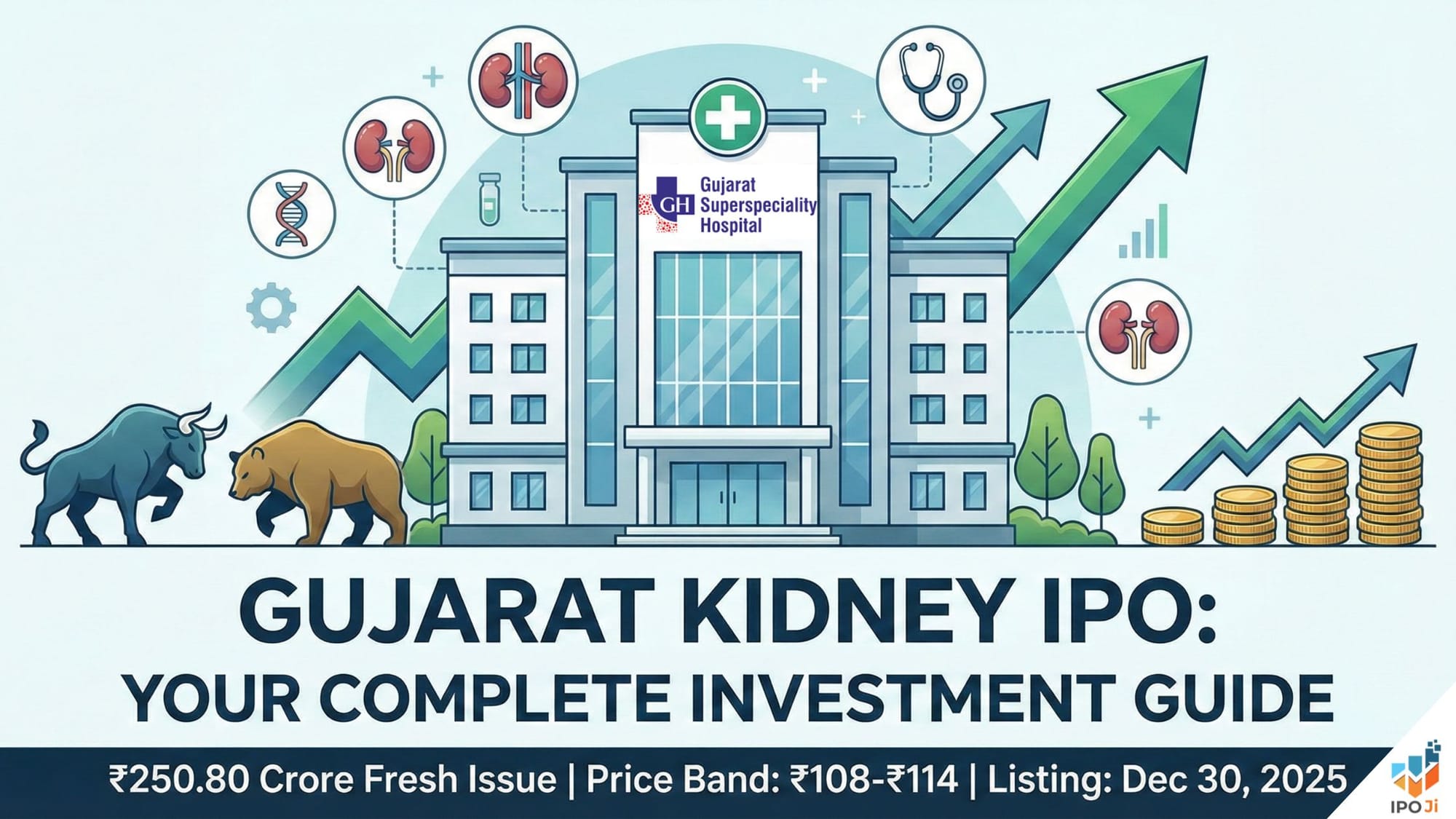
Your Complete Investment Guide for Gujarat Kidney IPO
The Gujarat Kidney & Super Speciality Limited (GKASSL) IPO represents a significant opportunity in India's booming healthcare sector, which is expected to reach ₹7.7 trillion by FY27. This ₹250.80 crore fresh issue offers investors exposure to one of India's fastest-growing hospital chains operating in central Gujarat. With a price band of ₹108-₹114 per share and a tentative listing date of December 30, 2025, this blog provides everything you need to know before applying, including detailed investment analysis, application procedures, and valuation metrics. Whether you're a retail investor exploring your first IPO or an HNI looking for healthcare sector exposure, this comprehensive guide will help you make an informed investment decision.
What is Gujarat Kidney IPO? Understanding the Basics
About Gujarat Kidney & Super Speciality Limited
Incorporated in 2019, Gujarat Kidney and Super Speciality Limited operates a chain of multispeciality hospitals across central Gujarat, establishing itself as a key regional healthcare provider with significant expertise in renal sciences and super-speciality services. The company specializes in providing secondary care (general and surgical treatments) and tertiary care (super-speciality surgical procedures) across multiple locations in Gujarat, India.
The company operates 7 multispeciality hospitals and 4 pharmacies with an impressive total bed capacity of 490 beds, an approved capacity of 455 beds, and an operational capacity of 340 beds. These facilities are strategically located in premium healthcare hubs including:
- Gujarat Kidney and Superspeciality Hospital (Vadodara)
- Gujarat Multispeciality Hospital (Godhra)
- Raj Palmland Hospital Private Limited (Bharuch)
- M/s. Surya Hospital and ICU (Borsad)
- Gujarat Surgical Hospital (Vadodara)
- Ashwini Medical Centre (Anand)
- Ashwini Medical Store (Anand)
The company has built a reputation for pre-eminence in renal sciences with established sub-specialities in urology, backed by a strong team of 89 doctors, 332 nurses, and 338 other staff members as of June 30, 2025.
IPO Issue Structure: Fresh Capital for Expansion
The Gujarat Kidney IPO is structured as a ₹250.80 crore fresh issue comprising 2.20 crore equity shares with a face value of ₹2 per share. The entire issue is fresh capital, meaning 100% of the shares are newly issued by the company (no existing shareholders are selling). This capital will fuel aggressive expansion through acquisitions, capex investments, and strategic growth initiatives.
Gujarat Kidney IPO Timeline: Key Dates You Must Know
Complete Timeline for Investors
Understanding the IPO timeline is crucial for planning your investment and tracking your allotment status. Here's the complete timeline:
Action Item: Mark these dates on your calendar. Ensure your UPI mandate confirmation is completed by 5 PM on December 24, 2025, or your application may be rejected.
3. IPO Price Band, Lot Size & Investment Amount: How Much Should You Invest?
Understanding the Price Band
The price band for Gujarat Kidney IPO is set at ₹108 to ₹114 per share. This means during the IPO application window, investors can bid for shares within this range. The final issue price will be determined after the bidding period closes and will fall within this band based on demand and market conditions.
Pre-IPO Market Capitalization: At the upper price band of ₹114, the company values itself at ₹898.81 crores.
Lot Size and Minimum Investment
The lot size for Gujarat Kidney IPO is 128 shares per lot, which translates to:
- Minimum Lot Size: 1 lot
- Multiples: Applications must be in multiples of 128 shares
Investment Amounts by Investor Category
The minimum and maximum investment amounts vary significantly by investor category:
*Based on upper price band of ₹114 per share
Key Insight for Retail Investors: The minimum investment required is just ₹14,592, making this IPO accessible to mass-market retail investors. However, the maximum investment for retail is capped at ₹1,89,696 (13 lots).
4. IPO Allocation Breakdown: How Are Shares Reserved?
SEBI Allocation Rules for Book-Built IPOs
Under SEBI regulations, the total issue size must be allocated across investor categories as follows:
What This Means:
- Retail investors have a dedicated quota of up to 10%, ensuring meaningful participation even if the IPO is massively oversubscribed
- If QIB or NII quotas are undersubscribed, unallotted shares are spilled over to other categories
- Retail investors have the highest probability of receiving at least one lot in oversubscribed IPOs
5. How to Apply for Gujarat Kidney IPO: Step-by-Step Process
What You Need Before Applying
Before you can apply for the Gujarat Kidney IPO, ensure you have:
- Demat Account: An active demat account with a registered SEBI-licensed depository participant (DP) like Zerodha, Angel One, ICICI Securities, etc.
- Trading Account: A trading account linked to the demat account (required for selling shares post-listing, not mandatory for applying)
- PAN Card: A valid Permanent Account Number from the Income Tax Department
- Bank Account: An active bank account linked to your demat account for blocking funds
- UPI ID: An active UPI handle linked to your bank account for payment processing
How to Apply for Gujarat Kidney & Super Speciality Limited (GKASSL) IPO Using IPO Ji
For IPO Ji users, the application process is designed to be simple, guided and beginner‑friendly:
- Search and open the IPO page
- Visit IPO Ji, go to the “Upcoming Mainboard IPOs” section, and open the “Gujarat Kidney & Super Speciality Limited (GKASSL) IPO” detail page.
- Review key highlights: issue size, price band, lot size, risk summary, GMP (if available), and live subscription numbers for QIB, NII and Retail.
- Login and verify your details
- Sign in with your registered mobile/email.
- Ensure your PAN, linked Demat (NSDL/CDSL) and UPI ID are correctly saved as per SEBI rules for UPI‑based applications.
- Select category and bidding details
- Choose your category: Retail, Shareholder (if you hold ICICI Bank shares), sNII or bNII, as applicable.
- Enter the number of lots you wish to apply for (minimum 1 lot = 6 shares for retail).
- Retail investors typically select the “Cut‑off” option to improve their chances of allotment, while HNIs must enter a specific price within the band.
- Confirm and approve UPI mandate
- Click “Apply” on IPO Ji; a UPI mandate will be sent to your UPI app for the total application amount.
- Approve the mandate before 5 PM on 16 December 2025; otherwise, your application will be rejected by the exchange.
- Track allotment & listing on IPO Ji
Option 1: Applying Online Through Your Broker/Depository
Step 1: Login to Your Broker/DP Platform
- Visit your broker's website or mobile app (Zerodha, Angel One, ICICI Securities, Kotak Securities, etc.)
- Login using your credentials and complete two-factor authentication
Step 2: Navigate to IPO Section
- Look for "IPO" or "Apply IPO" option in the main menu
- Search for "Gujarat Kidney IPO" or "GKASSL IPO"
- Review the IPO details provided
Step 3: Select Investment Details
- Choose the number of lots you wish to bid for (minimum 1, maximum as per your category)
- Enter your bidding price within the price band of ₹108-₹114
- Verify your demat account number, PAN, and address
Step 4: Link UPI and Authorize ASBA
- Enter your UPI ID (e.g., yourname@bankname)
- Accept the Application Supported by Blocked Amount (ASBA) authorization
- A payment mandate will be sent to your UPI app
Step 5: Confirm UPI Mandate
- Check your UPI app for the payment mandate from your depository
- Approve/confirm the mandate within 24-48 hours
- This is crucial: Failure to confirm within the deadline may result in rejection of your application
- The specified amount will be blocked in your bank account until allotment
Step 6: Submit Application
- Review all details one final time
- Click "Submit Application"
- Save the confirmation number/reference number for future tracking
Option 2: Applying Offline Through Your Bank (ASBA Method)
Visit Your Bank Branch
- Go to the branch of your bank that offers IPO subscription services
- Request the IPO application form for Gujarat Kidney IPO
Complete the ASBA Application Form
- Fill in all required details:
- Name (as per PAN)
- PAN number
- Bank account number
- Demat account details
- Number of shares/lots you wish to bid for
- Bidding price (within ₹108-₹114)
Provide Required Documents
- Demat account statement (last 3 months)
- PAN card photocopy
- Address proof
- Identity proof
Submit and Block Amount
- Submit the completed form to the bank
- The bank will block the application amount in your account
- Collect the acknowledgment slip with a unique reference number
Track Your Application
- Use the reference number on the acknowledgment slip to track your application status online
Pro Tips for Successful IPO Application:
Bid Strategy:
- For retail investors, consider bidding at the cut-off price (₹114) to maximize allotment chances
- Institutional investors may bid strategically within the band based on valuation analysis
Timing:
- Apply early in the IPO window to avoid last-minute technical glitches
- Don't wait until the closing day (December 24) when servers may be congested
Verification:
- Double-check your demat account details, PAN, and investment amount before submitting
- Ensure your UPI mandate is confirmed well before the 5 PM deadline on December 24
Allotment Certainty:
- Retail investors are more likely to receive allotment, especially if the IPO is oversubscribed
- HNI allotments are proportionate, so larger investments have lower percentage allotment probability
Gujarat Kidney IPO Financial Performance: Is This Company Profitable?
Impressive Financial Growth Trajectory
Gujarat Kidney's financial performance demonstrates exceptional growth and profitability, making it an attractive proposition for growth-focused investors:
Revenue and Profitability Metrics
Key Observations:
- Revenue Growth (FY23 to FY25): Increased from ₹0 to ₹40.40 crores (though this includes the period of expansion from 2019 incorporation)
- Profit After Tax Growth (FY24 to FY25): Rose by 454% (from ₹1.71 Cr to ₹9.50 Cr)
- Revenue Growth (FY24 to FY25): Surged by 637% (from ₹5.48 Cr to ₹40.40 Cr)
- EBITDA Growth: Improved from ₹1.95 Cr in FY24 to ₹16.55 Cr in FY25 (approximately 750% growth)
This explosive growth reflects the company's successful operational scaling and market expansion.
Profitability Metrics: How Efficiently Is the Company Operating?
Return on Equity (ROE) and Return on Capital Employed (ROCE)
Profit Margin Analysis
Balance Sheet Strength
Valuation Analysis: Is Gujarat Kidney IPO Fairly Priced?
Earnings Per Share (EPS) Analysis
Price-to-Book (P/B) Ratio
Use of IPO Proceeds: Where Is Your Money Going?
Detailed Breakdown of ₹250.80 Crore Capital Allocation
Understanding how the company plans to use IPO proceeds is crucial for assessing the growth runway. Here's the detailed allocation:
Key Strategic Insights:
- Geographic Expansion: The ₹77 crore Parekhs Hospital acquisition in Ahmedabad marks the company's entry into a tier-1 city, moving beyond its current central Gujarat focus. Ahmedabad is a major medical tourism hub with significant healthcare demand.
- Organic Growth: ₹30.10 crore for a new hospital in Vadodara demonstrates commitment to organic expansion while maintaining the asset-light model through acquisitions.
- Technology Upgradation: ₹6.83 crore for robotics equipment indicates investment in advanced surgical capabilities, a key competitive differentiator in modern healthcare.
- Strategic Optionality: The largest allocation (~44.8%) is for "unidentified acquisitions and general corporate purposes," providing management flexibility to capitalize on opportunistic M&A targets in the fragmented Indian healthcare sector.
Asset-Light Business Model: Why This Matters
Understanding Gujarat Kidney's Growth Strategy
Gujarat Kidney operates an asset-light business model, a crucial differentiator that enhances profitability and return metrics:
Current Asset-Light Arrangements
Why Asset-Light Model Benefits Investors
- Higher Capital Efficiency: By leasing rather than owning facilities, the company avoids heavy capex, improving ROCE and ROE
- Faster Expansion: Lease agreements enable rapid scaling without waiting for land acquisition or construction
- Lower Financial Risk: Reduced debt requirements mean lower financial leverage and bankruptcy risk
- Improved Margins: Operating leverage from service delivery without proportional asset growth
- Geographic Flexibility: Can move or exit markets more easily than asset-heavy competitors
Upcoming Shift: With the Parekhs Hospital acquisition in Ahmedabad, the company will own a major operational facility, slightly increasing its asset base but providing a strategic foothold in a major market.
Market Opportunity: Why Invest in Healthcare Now?
India's Healthcare Sector: A Multi-Decade Compounder
Market Size and Growth
Listing Expectations: What Could Be the Listing Day Returns?
Factors Affecting Listing Day Performance
IPO Grey Market Premium (GMP)
The Grey Market Premium (GMP) provides the most reliable indicator of listing day returns. GMP is the difference between the grey market trading price and the IPO issue price, reflecting investor sentiment before official listing.
How GMP Works:
- If IPO issue price is ₹114 and GMP is ₹50, the grey market price is ₹164
- Expected listing price ≈ ₹164 (issue price + GMP)
- Expected listing day gain ≈ 44% (₹50 / ₹114)
Note: GMP is an unofficial indicator and not guaranteed. Actual listing could be higher or lower.
Tracking Your Allotment and Listing Journey
After You Apply: What Happens Next?
Allotment (December 26, 2025)
What to Do:
- Check allotment status on your broker's website using your application reference number
- Log into the official IPO registrar website: https://linkintime.co.in
- Look for "Initial_Offer" → "public-issues" → "Gujarat Kidney IPO"
Possible Outcomes:
- Full Allotment: You received all shares you applied for (more common for retail)
- Partial Allotment: You received fewer shares than applied for (more common for HNI)
- No Allotment: Your application wasn't selected (less likely for retail in oversubscribed IPOs)
Refunds and Demat Credit (December 29, 2025)
If Full Allotment:
- Blocked funds released on December 29
- Allotted shares credited to your demat account on December 29
- You can view shares in your demat statement
If Partial Allotment:
- Excess blocked amount refunded to your bank account
- Allotted shares credited to your demat account
- Refund typically processed within 2-3 business days
If No Allotment:
- Full blocked amount refunded to your account
- Check your bank account for the refund by December 29
Listing (December 30, 2025)
What to Do:
- Your shares will be automatically available for trading on BSE and NSE
- You can sell your shares at market price (no lock-in period for retail investors)
- Remember: Selling incurs brokerage charges (typically 0.03-0.1% of transaction value)
Competitive Landscape: How Does Gujarat Kidney Stack Up?
Regional and National Competition
Peer Comparison: Key Metrics
While direct comparable data is limited for regional players, here's how Gujarat Kidney compares to India's healthcare sector:
Important Contacts and Resources
Lead Manager and Registrar Details
Lead Manager: Nirbhay Capital Services Pvt. Ltd.
- Website:
- https://nirbhaycapital.com
- Red Herring Prospectus (RHP):
- https://nirbhaycapital.com/wp-content/uploads/2025/12/GKASSL_RHP_F.pdf
Registrar: MUFG Intime India Pvt. Ltd.
- Phone: +91-22-4918 6270
- Email:
- gujaratkidney.ipo@in.mpms.mufg.com
- Website:
- https://linkintime.co.in/Initial_Offer/public-issues.html
Company Details
Gujarat Kidney & Super Speciality Limited
- Address: Plot No. 1, City Sarve No. 1537/A, Jetalpur Road, Gokak Mill Compound, Alkapuri, Vadodara, Gujarat 390020
- Phone: +91 265 298 4800
- Email:
- info@gujaratsuperspecialityhospital.com
- Website:
- http://www.gujaratsuperspecialityhospital.com/
Key IPO Details Summary
Disclaimer: This blog is for educational purposes only and should not be considered financial advice. Consult a qualified financial advisor before making investment decisions. Past performance and sector trends do not guarantee future returns. IPO investing carries significant risk, including loss of capital.