The December 2025 IPO Super-Cycle: A Definitive Investment Thesis & Market Intelligence Report
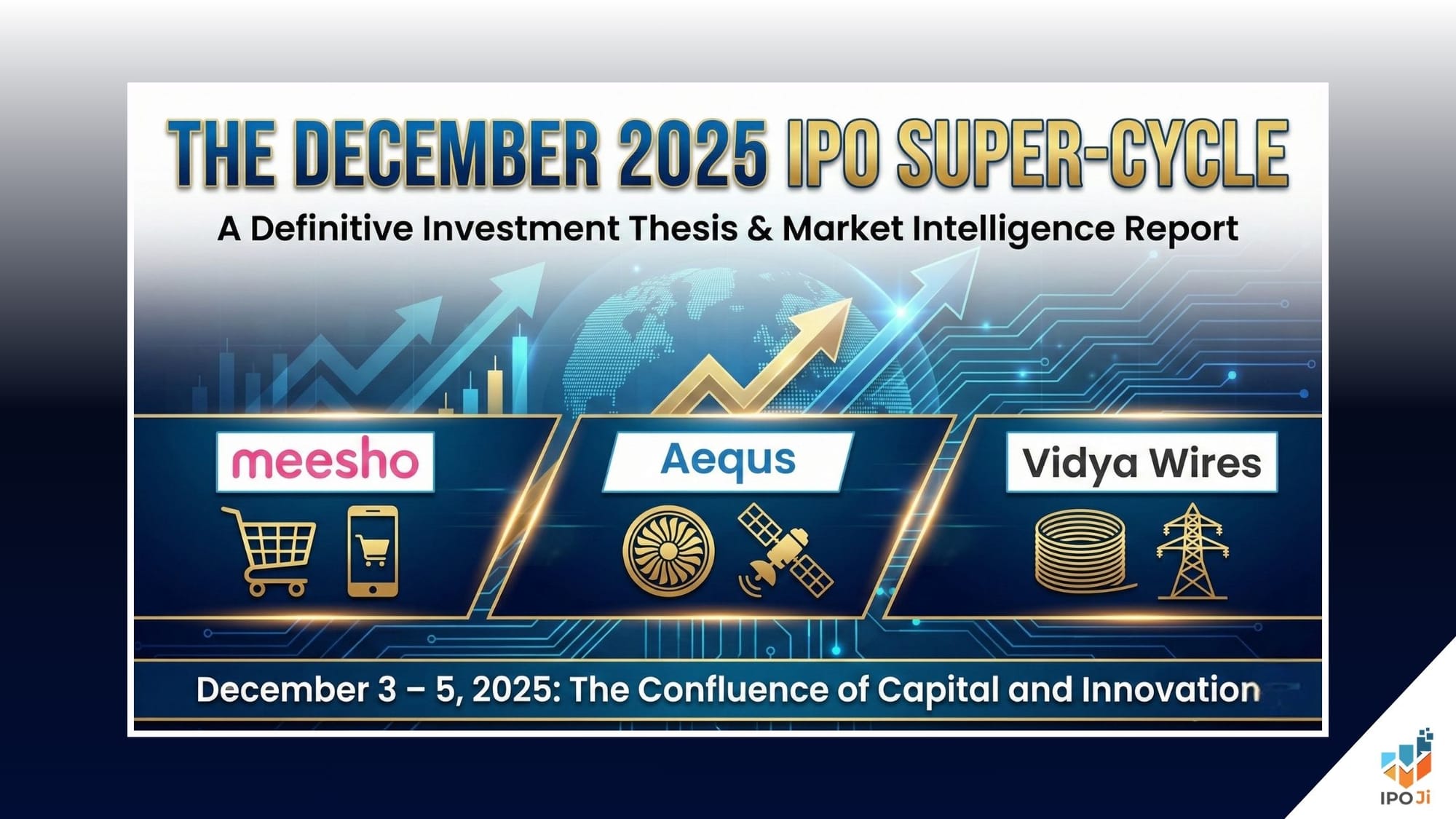
The Confluence of Capital and Innovation
The first week of December 2025 is poised to become a watershed moment in the annals of India's primary capital markets. In a rare alignment of regulatory approvals, market liquidity, and corporate strategic intent, three distinct sectoral narratives are converging to mobilize approximately ₹6,643 crore from the public markets between December 3 and December 5, 2025. This simultaneous issuance—comprising Meesho Limited, Aequs Limited, and Vidya Wires Limited—offers institutional and retail investors a cross-sectional bet on the Indian economy, spanning the high-velocity world of digital commerce, the strategic imperatives of aerospace defense manufacturing, and the foundational industrial demand for conductivity solutions.
This comprehensive research report serves a purpose. It provides an exhaustive, expert-level financial and strategic analysis of these three issuers, designed for sophisticated market participants who require a nuanced understanding of valuation multiples, risk-adjusted returns, and competitive moats. By synthesizing data from Red Herring Prospectuses (RHPs), grey market premium (GMP) trends, and competitive benchmarking, this report aims to be the ultimate guide for navigating the "Super Week" of December 2025.
The sheer diversity of these offerings allows for portfolio construction that balances high-growth technology risk with deep-value industrial stability. Aequs Limited offers a leveraged play on the global aerospace supply chain realignment, albeit with a financial profile that demands a high risk appetite. Vidya Wires presents a classic "margin of safety" investment, trading at a significant discount to listed peers while capitalizing on the secular themes of electrification and electric mobility.
The "Super Week" Snapshot (December 3–5, 2025)
The structural dynamics of this week are defined by the concurrent subscription windows, forcing capital allocators to make rapid, comparative decisions. All three issues open on Wednesday, December 3, 2025, and close on Friday, December 5, 2025, with a tentative listing date scheduled for December 10, 2025. This synchronization creates a unique liquidity event where investor funds will be locked across three distinct risk profiles simultaneously.
Data compiled from RHP filings and market intelligence as of December 1, 2025.
The allocation of funds reveals the strategic priorities of each issuer. Meesho’s massive fresh issue component of ₹4,250 crore is earmarked for technology infrastructure and logistics, signaling a continued aggressive expansion into the hinterlands of India. Aequs is utilizing its ₹670 crore fresh issue primarily for debt repayment and capital expenditure, a necessary step to repair its balance sheet after significant goodwill impairments. Vidya Wires, with the highest proportion of fresh equity (91%), is directing funds toward capacity expansion to meet the burgeoning demand from the electrical systems, electric mobility, railways, clean energy and power sectors.
Macro-Economic Backdrop and Primary Market Sentiment
To fully appreciate the significance of these IPOs, one must contextualize them within the broader economic environment of December 2025. The Indian equity markets have demonstrated remarkable resilience, decoupled to a large extent from global headwinds. The primary market, in particular, has witnessed a record-breaking year, with 96 companies mobilizing over ₹1.53 lakh crore prior to December, surpassing previous historical peaks.
The "Santa Rally" and Liquidity Dynamics
The concept of a "Santa Rally" in December is a recurring phenomenon in global markets, where year-end optimism drives equity valuations higher. In 2025, this sentiment is amplified by sustained domestic institutional inflows and a renewed retail appetite for high-growth assets. The GMP trends for Meesho, Aequs, and Vidya Wires—trading at premiums (check here), days before the issue opens—indicate a surplus of liquidity chasing quality paper. This pre-market enthusiasm is not merely speculative; it is underpinned by strong anchor investor interest, with marquee funds locking in positions early, thereby reducing the float available for the general public and driving up demand dynamics.
The "Make in India" Defense Premium
Parallel to the tech narrative is the surging interest in defense and aerospace manufacturing. The government's push for indigenization and the global "China+1" strategy have led to a re-rating of companies like HAL, BEL, MTAR Technologies, and Azad Engineering. Aequs Limited enters the market at the crest of this wave. Despite its financial challenges, the market is willing to assign a scarcity premium to Aequs due to its specialized capabilities in precision machining and its strategic location in the Belagavi Aerospace Cluster. The willingness of investors to look past current losses in favor of future order book visibility is a testament to the structural bullishness on India's manufacturing renaissance.
Deep Dive Analysis: Meesho Limited
Strategic Positioning: The "Bharat" Commerce Engine
Meesho has fundamentally altered the genetic makeup of Indian e-commerce. While Amazon and Flipkart engaged in a capital-intensive battle for the urban, English-speaking affluent consumer (India 1), Meesho quietly built a fortress in "India 2" and "India 3"—the Tier-2, Tier-3, and Tier-4 cities where aspirations are high but disposable incomes are value-constrained.
The Asset-Light Disruption:
Unlike its competitors who invested billions in warehousing and inventory, Meesho pioneered a pure-play marketplace model. It owns no inventory. Instead, it acts as a digital conduit connecting millions of small sellers (MSMEs) directly to consumers. This asset-light structure allows for rapid scalability with minimal capital expenditure.
- Zero Commission Model: In a masterstroke of user acquisition, Meesho charges zero commission from sellers, monetizing instead through advertising and fulfillment services. This has led to a supply-side explosion, with the platform hosting over 700,000 sellers.
- User Demographics: The platform boasts an annual transacting user base of nearly 199 million, with a staggering 174 million users residing outside India's top 8 cities.This demographic is stickier and less prone to platform-hopping compared to the deal-seeking urban elite.
Financial Engineering: The Turnaround of the Decade
The most compelling argument for the Meesho IPO is its financial transformation. For years, the criticism leveled against Indian e-commerce was "profitless growth." Meesho has shattered this narrative in FY25.
Free Cash Flow (FCF) Leadership:
In FY25, Meesho emerged as the single largest generator of Free Cash Flow among listed new-age internet commerce companies in India. The company reported a positive FCF of ₹1,032 crore (including interest income), a dramatic swing from a negative FCF of ₹2,336 crore in the previous year.6
- Why this matters: FCF is the ultimate truth in finance. It represents the cash a company generates after accounting for cash outflows to support operations and maintain its capital assets. Unlike accounting profits, which can be manipulated, cash flow is tangible.
- Comparison: While Zomato reported a negative FCF of ₹628 crore and Swiggy burned ₹2,920 crore, Meesho’s efficient supply chain and ad-led monetization model allowed it to print cash.
Revenue and Loss Trajectory:
- Revenue: Operational revenue for FY25 stood at ₹5,735 crore, with some gross merchandise value (GMV) adjusted estimates reaching ₹9,390 crore.
- Net Loss: The net loss for the April-September 2025 period narrowed to ₹700.71 crore, down from ₹2,512.89 crore in the same period of the previous year.This trajectory suggests that the company is on the cusp of breaking even on a Net Profit (PAT) basis, likely by FY26 or FY27.
Comparative Valuation: The Price-to-Sales Arbitrage
To understand whether Meesho is cheap or expensive, one must look at the Price-to-Sales (P/S) multiple, the standard metric for valuing high-growth, loss-making tech companies.
The Valuation Matrix:
At 5.6x Sales, Meesho is priced at a roughly 75% discount to where Nykaa and Zomato traded at their IPOs. This is a massive "Margin of Safety." Even if the market corrects, the downside from 5.6x sales is significantly lower than from 20x sales. The market is effectively pricing Meesho not as a hyper-growth tech stock, but as a maturing consumer platform, which paradoxically makes it a more attractive investment. This pricing strategy is likely driven by the need to ensure a "pop" at listing to restore faith in the IPO markets after recent lackluster debuts.
Deep Dive Analysis: Aequs Limited
Strategic Positioning: The Precision Manufacturing Moat
Aequs Limited operates in a sector with high entry barriers: aerospace precision manufacturing. Headquartered in Belagavi, Karnataka, the company has established India's first notified precision engineering Special Economic Zone (SEZ). It is a vertically integrated manufacturer, meaning it controls multiple stages of the production process—from forging to machining to surface treatment—allowing for better margin control and stickier client relationships.
Key Clients & Capabilities:
Aequs serves the giants of the aerospace world, including Airbus, Boeing, and Safran. It manufactures critical components like structural parts for wings, fuselages, and engine components.2 In an era where global OEMs are desperate to diversify supply chains away from China (the "China+1" strategy), Aequs is perfectly positioned to capture this shifting demand.
Financial Forensics: Understanding the Losses
A superficial look at Aequs’ financials raises red flags. The company reported a significant widening of losses in FY25.
The Loss Bridge:
- FY24 Net Loss: ₹12.14 Crores
- FY25 Net Loss: ₹102.4 Crores.
- Revenue: Declined marginally from ₹988 Cr (FY24) to ₹959 Cr (FY25).
The "Goodwill" Impairment:
Crucially, a large portion of the FY25 loss (₹48.3 Crore) is due to an "impairment loss on goodwill" related to its subsidiary, Aequs Force Consumer Products.8 This is a non-cash charge. It means the company admitted that an acquisition it made in the past is worth less than what they paid for it. While this impacts the P&L statement, it does not affect the cash balance or the operational capability of the aerospace division. Investors need to distinguish between operational losses and accounting write-offs.
However, the revenue stagnation (-4.19%) is a genuine concern in a growth sector. It suggests execution challenges or order delays, which are common in the long-cycle aerospace industry.
Valuation Benchmarking: The "Scarcity" Premium
Despite the losses, Aequs commands a high GMP. This is because the market values defense/aerospace companies on their order book and future potential, not just current earnings.
Peer Comparison:
Aequs is actually larger in revenue terms than both MTAR and Azad Engineering. Yet, its valuation (Market Cap) is lower than Azad’s. On a Price-to-Sales basis, Aequs is trading at ~8.6x, significantly cheaper than Azad (20.5x) and MTAR (11.8x). The market is effectively applying a "performance discount" to Aequs due to its lack of profitability. If Aequs can turn profitable, the re-rating potential is massive, as it could trade at 15-20x sales like its peers.
Deep Dive Analysis: Vidya Wires Limited
Strategic Positioning: The Backbone of Electrification
Vidya Wires is the "pick and shovel" play of the Indian infrastructure story. Established in 1981, it manufactures copper and aluminium winding wires, strips, and busbars. These are unglamorous but essential components used in transformers, generators, electric vehicles (EVs), and railway traction motors.
Drivers of Demand:
- EV Revolution: Every electric vehicle requires significantly more copper winding wire than an internal combustion engine vehicle.
- Power Infrastructure: India's push for 500GW of renewable energy requires massive investments in transmission and distribution, directly benefiting wire manufacturers.
- Railways: The electrification of the Indian Railways network drives sustained demand for conductivity products.
Financial Stability: The Value Compounder
Vidya Wires offers the most stable financial profile of the three IPOs. It is not a hyper-growth story, but a consistent compounder.
- Revenue Growth: Revenue grew from ₹1,011 crore in FY23 to ₹1,486 crore in FY25, a CAGR of ~21%.
- Profitability: Net profit nearly doubled from ₹21.5 crore (FY23) to ₹40.87 crore (FY25).
- Margins: Net margins are thin (~2.75%), which is typical for the metal conversion industry where raw material costs (copper) are passed through. The focus here is on volume growth and return on capital.
Valuation Arbitrage: The "Deep Value" Opportunity
Vidya Wires is priced to sell. The valuation gap between it and its listed peers is striking.
Peer Comparison:
Vidya Wires has a superior ROE (24.57%) compared to Precision Wires (15.63%) and Ram Ratna (14.39%), yet it is asking for a P/E of only 27x compared to their 42x-53x. This is a classic arbitrage opportunity. The market is likely to re-rate Vidya Wires post-listing to narrow this gap.
Disclaimer: This report is for educational purposes only. Equity investments are subject to market risks. Please consult a SEBI-registered investment advisor before making any financial decisions.